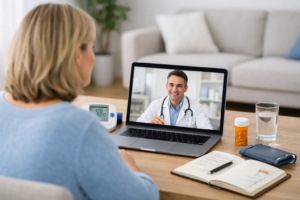

Online healthcare is no longer a development planned for launch in the future. Millions of Americans now rely on virtual platforms for minor illnesses, prescription refills, and routine medical advice.
Since the time COVID-19 forced everyone to stay at home without warning, options like same day online doctor consultation USA, fast online doctor visit USA, and other digital care options in telemedicine have gained more popularity. You won’t be wrong to even say they have now become part of mainstream healthcare delivery.
The more popular this online healthcare gets and the more people adopt it, the more people have questions about it. One of the questions people often ask is, “Is online healthcare really safe?”
If you also have the same question, rest assured, you are reading the right guide. This article explains how telemedicine protects your privacy, how the doctors on telehealth platforms are licensed and verified, and how your prescriptions are handled on the platform.
You will also learn about when telemedicine should be considered and when it should not. If you have ever wished you could talk to a doctor online without appointment or considered an online doctor visit without long wait but are not sure about how your privacy is handled, this guide will help you understand the safety systems behind virtual care.
What Online Healthcare Really Means
We can’t talk about how safety matters in online healthcare without first understanding what online healthcare itself really involves.
When you visit legitimate telemedicine platforms, they will always connect you with licensed physicians or nurse practitioners through secure systems.
Your consultations can happen through encrypted video, secure messaging, or structured medical intake forms. Regardless of the mode, “secure” is the keyword.
And when you opt for an option like a telehealth appointment same day USA, you are not just getting random internet advice; you will be speaking with certified and licensed medical practitioners. These professionals possess extensive knowledge and adhere to standard medical practices.
Virtual care is commonly used for:
- Cold & Flu
- Sinus Infection
- Urinary tract infections
- Skin rashes
- Mild asthma symptoms
- Acne
- General Anxiety
- Depression
- Medication refills
For example, if you get a virtual doctor for cold and flu USA, your online doctor will assess your symptoms, review your medical history, and recommend an effective treatment for you. A telemedicine visit for cold and flu follows the same medical guidelines as the ones followed in in-person visits. The only difference is the method of getting the care, which is online in the case of virtual care.
Moreover, the reason many adults use an online doctor visit for minor illness USA is because of how it removes waiting room issues and scheduling delays that are common with traditional care.
Reputable telemedicine platforms, however, do not operate unchecked. They operate under federal and state healthcare regulations. They are required by the law of the state to protect your data and also make sure their clinicians meet the required licensing standards to operate.
How Does Online Healthcare Protect Patients’ Privacy?
One of the biggest concerns many people have about online healthcare is the security of their data. How is it managed? What do the platforms do with it? People are concerned about whether their medical history, prescriptions, or diagnoses are exposed online.
In the United States, telemedicine providers must comply with HIPAA (Health Insurance Portability and Accountability Act). HIPAA establishes strict rules around Protected Health Information (PHI).
What HIPAA Requires
- Encryption of digital communications (although it is introduced as ‘addressable implementation specification’)
- Secure storage of electronic medical records
- Restricted access to patient information
- Audit trails for system access
- Administrative and technical safeguards
Even though HIPAA listed encryption of digital communications as “addressable,’ meaning that it is not mandatory for every interaction to be encrypted, most reputable telehealth platforms still encrypt your exchange with them.
For instance, when you book an online medical consultation same day, your information will be transmitted through encrypted systems just like the ones used in online banking.
Also, during a same day virtual doctor appointment USA with a reputable platform, your video sessions are encrypted end-to-end. That means a hacker or any other unauthorized third party cannot intercept your consultation.
If you use an online doctor visit for skin rash, your photos and medical data will also be stored in secure patient portals and not public servers.
Platforms that offer online doctor visit without insurance usa are still legally required to protect your data. Your insurance status does not change the privacy protections.
You should also know that even if you access virtual healthcare services for busy professionals from your phone, HIPAA compliance still applies.
No legitimate telemedicine providers can legally sell your identifiable health information. They are bound by federal privacy laws just like physical clinics.
How Online Doctors Are Licensed and Verified
Another common concern people usually have is whether online providers are “real doctors.” Like, how can you tell they are not just good actors wearing nice scrubs and other medical costumes?
Your concerns are valid, and you won’t be wrong if you ask those questions. Now, try reading this carefully if you live in the US:
In the United States, any physician at all practicing telemedicine must hold valid medical licenses in the state where the patient is located. This is regulated by state medical boards and overseen nationally by the Federation of State Medical Boards (FSMB).
When you talk to a licensed doctor online USA, that provider:
- Has completed medical school
- Has passed national licensing exams
- Is licensed by a state medical board
- Is subject to disciplinary oversight
Telemedicine does not lower the licensing bar. It only changes the way care is delivered.
If an online physician prescribes any medication during an online doctor consultation no long wait, that prescription carries the same legal accountability as the one that is written in a physical clinic.
Is It Safe to Get Prescriptions Online?
Electronic prescribing (e-prescribing) is regulated at both federal and state levels. The Drug Enforcement Administration (DEA) oversees how medications are transmitted electronically.
When you see a doctor online for prescription refill, the provider will review:
- Your medical history
- The current medications You have
- Your allergies
- The symptoms you have
- Your risk factors
If a prescription is befitting in your case, your online physician will send it electronically to a licensed pharmacy of your choice.
An online doctor for prescription refill USA does not bypass standard safety protocols. Your provider is bound by law to follow standard medical prescribing guidelines. Many telemedicine platforms restrict controlled substances, or they may require additional verification.
Moreover, electronic systems reduce errors by eliminating illegible handwriting, which is often common with many physical prescription notes many doctors give.
It doesn’t matter whether you book a cheap online doctor consultation USA or an affordable telemedicine visit USA, rest assured, every prescription your online doctor gives you from a reputable telehealth platform follows standard medical prescribing safety standards.
When Online Healthcare Is Safe and Appropriate
Telemedicine works best when the condition is not a medical emergency. You should never consider telemedicine for medical matters that require an instant emergency room.
Below are some common medical issues telemedicine is very effective for:
- Cold & Flu
- Sinus infections
- Pink eye
- Mild asthma
- Urinary tract infections
- Seasonal allergies
- Migraine headaches
- Mild skin conditions
- Work notes
- Chronic disease management
For example, in a virtual doctor visit for sinus infection, your online doctor will review your symptoms, discuss your medical history with you, and give you a fitting treatment plan from wherever you are.
A telemedicine for uti treatment USA can also assess your urinary symptoms and determine whether antibiotics are the right choice or not.
A virtual doctor visit for uti treatment is an effective option for adults who need quick care and don’t want to go through all the delays that are associated with clinic visits.
However, telemedicine platforms are only designed for non-emergency conditions. We are not facing a situation of telemedicine care vs. in-person care. Each of them has their strengths and weaknesses.
At any rate, telemedicine care is no substitute for emergency departments. In the next section, you will learn about emergency conditions you should not treat with online healthcare.
When Online Healthcare Is NOT Appropriate
Online healthcare is not appropriate for:
- Chest pain
- Severe shortness of breath
- Stroke symptoms
- Heavy bleeding
- Major trauma
- Severe allergic reactions
If you or someone you know experiences life-threatening symptoms, do not hesitate to contact the emergency services in your state. NEVER attempt to treat an emergency case online.
Even a fast online doctor consultation America cannot manage acute emergencies that require imaging, surgery, or advanced monitoring.
If your symptoms exceed what you can safely manage or treat online, ethical telemedicine providers will always direct you to emergency care.
Common Security Concerns: Myths vs Reality
Myth 1: “My data will be hacked.”
Reality: Reputable platforms protect your data with encryption, secure servers, and multi-layer authentication. The security standards are like the ones major financial institutions use.
Myth 2: “Online diagnoses are rushed.”
Reality: Your online doctors are bound by the same law that applies to your physical doctors. They follow the same standard medical procedures all physical clinics and hospitals follow.
Myth 3: “Online care is lower quality.”
Reality: Think of your online doctors as the same kind of consultants you meet in clinics or major hospitals, because that’s exactly how it is. The difference is just in the delivery of the care you get, which is usually online, and also the fact that online care does not address medical emergencies.
Who Benefits Most from Safe Online Healthcare
Telemedicine is for everyone, and certainly all kinds of people benefit from it. However, we listed below some people who significantly benefit from telemedicine:
- Busy people who have work to attend to: These people usually use virtual healthcare services for busy professionals, which allows them to have flexible scheduling and shorter appointment times.
- People who live in a rural area: Telemedicine removes transport issues for these people.
- Adults who are not insured: Telemedicine gives these people options like affordable telemedicine for minor illnesses and online urgent care without insurance, which provides cost transparency.
- Adults who are managing minor infections: With telemedicine, these people can access an option like telehealth services for common infections, which makes it easier to address their conditions without unnecessary delays.
- People who want speed: For these people, there are options like fast online doctor visit USA and online doctor consultation no long wait, which enable them to get the care they need without losing significant time.
The Bottom Line: Is Online Healthcare Safe?
Yes, online healthcare is safe when you use legitimate platforms.
- Online healthcare is regulated
- Their providers are licensed
- The prescriptions you get are given by certified professionals
- Your data is encrypted
- HIPAA protections also apply.
The most important thing is for you to use a reputable platform and also understand telemedicine is not applicable when you are having a medical emergency.
What Next Steps Should You Take?
If your symptoms are mild, or you need a prescription refill, or what you want is just medical advice without having to wait for days to get an appointment, then you can book a same day virtual doctor appointment USA.
You can talk to a doctor online without appointment, receive the professional guidance, and access the care you need without stepping out of your house.
Online healthcare provides a reliable solution for conditions that are not medical emergencies, and it does it with secure systems, licensed providers, and by following standard medical procedures you would expect in any approved hospital.