
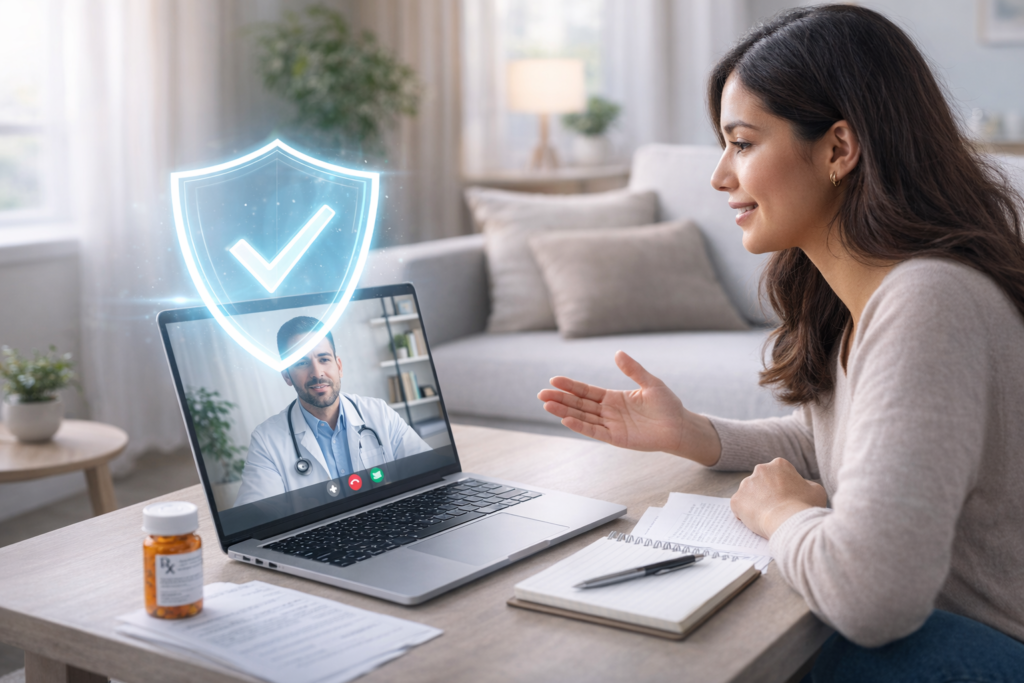
Doctor visits online have ceased to be a niche product but a mainstream health care product. To most individuals, it is almost a natural experience to be able to see a doctor using a phone or laptop. However, with the increasing telemedicine, a question continues to emerge:
Can online visits with a doctor be considered quite valid and safe?
The answer to this is yes, but when done right. The more complex answer takes the form of a longer one, and that is what this article will discuss.
What is Legitimate about an Online Doctor Visit?
E-visits with a doctor are no different in terms of the basic medical principles as physical appointments. The environment may be different, but the norms are not.
In order to legally visit the online doctor, it must involve:
- A real medical consultation
- A qualified medical worker.
- Proper documentation
- Clarify parameters of what and what is not remotely treatable.
The majority of respectable sources place at the core of their model an online medical consultation same day, through which a clinician examines the symptoms, medical history, and any other details and provides any recommendations.
When a service does not take this important step before anything else, it should not be trusted.
Who You Actually Talk To Is Important
Whether they are talking to a real doctor is one of the greatest apprehensions of people who patronise telemedical practices. .
The correct channel would provide the patients with an opportunity to discuss their case with a licensed physician via the internet, which means that the practitioner is board-approved, regulated, and allowed to do business according to the law. This information should be readable and confirmable.
In cases where names of the physicians are not posted on the platform, it is a red flag.
So What Health Cases Are Safe For Online Visits?
The tele-physician appointments are focused on non-emergency and minor health problems. They work in those instances where the symptoms are widespread and can be characterized easily.
Examples include:
- Cold and flu symptoms
- Sinus infections
- Skin rashes
- UTIs
- Allergies
- Medication refills
These are often taken into the category of cases that can be treated with the assistance of a telehealth physician, who is authorized to treat mild cases since in most cases, visual examination and patient history may not be needed to administer treatment..
Safety Lies in knowing the Limits
The willingness to say no is one of the strongest indicators of a safe service of telemedicine.
Online care is supposed to serve as telemedicine care in the case of non-emergency. Physicians are to make it clear when an issue is beyond the limits of online care and prescribe in-person or emergency services.
Social networks that advertise the possibility of treating everything at a distance are not acting responsibly.
Is it safe to get prescriptions online?
When handled properly, yes.
Online prescribing of medication is not regarded as illegitimate as long as it is done in reference to the medical recommendations and the licensed issuers. Patients who need refills often find online care the best option for their needs. Many people also use telemedicine to get the support of a doctor over the internet to have a prescription renewed, particularly in a case where one is dealing with a drug that has already been prescribed.
Any service that offers a prescription without proper evaluation is unsafe.
What of Cost and Insurance?
Affordability is one of the factors that have made telemedicine so popular. There are also a number of platforms with flat pricing and this can render care cheaper. In cases of uncovered patients, an insurance-free online visit with a doctor can be much cheaper than an urgent care visit or emergency room.
With that said, convenience is not more important than safety so proper medical evaluation that suits a specific case should never be substituted with lower costs.
Privacy and Confidentiality Issues.
Official telemedicine services must ensure that the information on patients is safeguarded as it is in the case of traditional clinics. This involves safe sites, coded messages and explicit privacy rules.
Patients ought to have the capability to comprehend the way their information is managed and preserved before they are booked.
Comfort vs Quality of Service.
The fact that one can book a doctor visit online at the comfort of their home is no doubt convenient. It eliminates the time of traveling, long queues and appointment headaches.
Nevertheless, convenience is not the determinant of quality. The quality of online visit is dependent on:
- The doctor’s qualifications
- The completeness of the consultation.
- The medical standards at the platform.
With these in place, online care can be as effective as face-to-face care under the right circumstances.
A Real-World Example
A lot of the current telemedicine systems have been made to be within the close medical standards, where consultation must be complete before any treatment decisions can be made. As an illustration, such services as FastDocNow provide online consultations in non-emergency cases and patients can have an opportunity to meet with licensed clinicians without any unnecessary delays.
When used in a responsible manner, platforms such as this demonstrate the ways in which telemedicine may be not only legitimate but also safe.
Online Doctor Visits: When It Is not the Right Option.
The online visits are not appropriate when:
- Symptoms are acute or fast deteriorating.
- You have chest pain or dyspnea.
- A diagnostic test is needed urgently.
- There must be a physical examination.
Face to face or emergency care is necessary in such circumstances.
Therefore, Are Online Doctor Visits Legit and Safe?
Yes, online doctor visits are legit and safe and all would go well when patients select reputable platforms and are aware of the limits of telemedicine.
Online visit to the doctor is secure when it:
- Involves qualified experts.
- Add pertinent medical examination.
- Understands the remote care drawbacks.
- Make referrals to face-to-face care.
Telemedicine is not a harmful short cut when used in a proper way. It is a reasonable, regulated extension of modern healthcare.