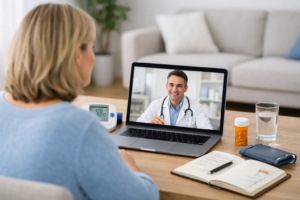

The modern picture of healthcare is quite different from what it was a decade ago. The question of whether or how, is no longer a question to many individuals. The question is now whether it is better to make an online appointment or visit a clinic?
The answer to that question is not as simple as one being better than the other. These are both alternatives that suit various purposes and knowing where one of them works best can enable you to make more intelligent choices regarding your care.
What Is a Telehealth Doctor Visit?
Telemedicine or telehealth online doctor visit is an alternative way to visit a medical professional remotely via video calls or phone calls or secure messaging. You can call a doctor on your phone or computer instead of waiting in a queue.
To most patients, it is the availability of online medical consultation within the same day especially when the medical cases do not need a physical examination that seals the deal when deciding between telemedicine and a physical doctor visit.
Internet care has increased at a high rate since most of the restrictions people experience with traditional medical care, such as traveling, time related complications, and wait period, are eliminated.
What Does a Face-to-Face Doctor Visit Entail?
The conventional model of care is in-person visits. You literally go to a clinic, hospital, or personal practice and a doctor is able to directly examine you, conduct tests in the office, and even give you direct hands-on treatment as necessary.
This model is essential for:
- Physical examinations
- Radiographic tests and laboratory tests.
- Emergency and complicated situations.
- Equipment needed procedures.
Face-to-face care cannot be replaced in most instances.
Speed and Convenience: An Obvious Dissimilarity.
Speed is one of the most notable contrasts between online doctors and doctors in person.
Online visits tend to be fast in nature. A considerable number of platforms provide patients opportunities to communicate with a clinician within minutes or hours. This renders online care attractive to individuals who require the answers fast but do not wish to spend days to get an appointment.
On the other hand, face-to-face visits usually comprise:
- Reservation of days or weeks.
- Travel time
- Waiting rooms
- Administrative delays
In case of minor problems, such delays may seem unnecessary to a problem.
In Which circumstances would Online Doctors be more appropriate?
Doctors online perform best in cases of simple symptoms that can be easily explained. This is where a telehealth doctor for mild symptoms would be of great help.
Common examples include:
- Colds and flu
- Sinus infections
- Sore throat
- Skin rashes
- UTIs
- Minor allergies
- Medication refills
These groups of concerns fall under virtual healthcare for common illnrsses, where visual information, the history of the patient, and description of the symptoms typically suffice to enable the doctor to make a decision.
When Is In-Person Care More Preferable?
Regardless of how convenient it can be to receive care online, there are cases when it is obvious that it is preferable to be visually examined by a doctor and consider it a more acceptable choice.
You need to give priority to in-person care when:
- Symptoms are critical or deteriorating.
- You have chest pain or dyspnea.
- A physical exam is necessary
- Lab or imaging is necessary.
- You have been told to make a physical follow up.
Emergency services and critical diagnostics cannot in any way be substituted by online care.
Cost and Insurance Flexibility
One of the most significant aspects that affect the choice of care in modern society is cost.
There are also greater opportunities of online doctor visits, which are more transparent and cheaper, particularly to uninsured patients. Numerous services have flat rates, and it is easier to afford care.
Telemedicine will be an option that can be a viable substitute to the expensive physical visits to the doctor in case the patient wants to visit an online doctor but is not insured.
Face-to-face visits, although crucial to most scenarios, in most instances, patients face increased costs in terms of facility charges, testing, and administration costs especially in the absence of insurance cover.
Flexibility to Access and Location.
The geographical barriers are eliminated with online healthcare. You do not have to be close to a hospital or have some means of transportation to get medical advice.
The fact that it is possible to make an online doctor appointment at home is particularly useful to:
- Busy professionals
- Parents and caregivers
- Individuals who are not mobile.
- Patients in remote areas
Face-to-face care, in its turn, has a limited range of the location and working hours.
Quality of Care: Is One Better?
This is where nuance matters.
Online doctors are licensed full professionals adhering to clinical guidelines and care standards. Under proper circumstances, care delivery is as good as in-person visits.
Nonetheless, online care has its limitations. Physicians have to be considerably dependent on self-reported symptoms and observation. This is why it is more efficient as telemedicine treatment for non-emergency cases rather than complicated medical issues.
Face-to-face care is more diagnostic in nature, but disadvantageous in terms of time and convenience.
Patient Experience: Feeling vs Detailing.
Others feel freer to talk at home in the safety of their hometown and not under the pressure of a clinic. Other people like the comfort of a physical check up and direct communication.
Neither preference is wrong. Healthcare is an intimate affair and comfort contributes to the effectiveness of care to the patient.
So… Which Is Better?
The genuine response: it is all situational.
Internet physicians are superior when:
- The symptoms are mild or known.
- Speed matters
- Cost is a concern
- Physical checkups are not necessary.
Face-to-face doctors are preferable when:
- The symptoms are severe or vague.
- Practical evaluation is required.
- Diagnostic tests are necessary.
To most individuals, the best way is not to pick one against the other but to combine them in a strategic manner.
A Real-World Example
A large number of telemedicine systems today are able to enable patients to chat with licensed clinicians about non-emergency medical issues like colds, sinus infection, UTI, or prescription refills. Services such as FastDocNow deliver online consultations on routine illnesses, frequent ones, without insurance and with a lengthy queue.
Such an option depicts how online care can be used in contemporary healthcare as a supplement, not an alternative.
Final Thoughts
Online and in-person doctors have different functions and the knowledge of the functions is how patients can make better choices related to healthcare. Telemedicine is fast, available, and more cost-effective whereas face-to-face care is detailed, diagnostic, and practical.
Instead of the question as to which is better, on the whole, the more practical question is:
What is more suitable to this particular requirement, at present?
Such a way of thinking results in wiser, more efficient treatment.