The most challenging aspect of healthcare to a lot of professionals is the disruption of their normal schedule rather than the illness.
Deadlines, travelling, meeting appointments and taking care of the family, it is almost always a logistical challenge to find time to make a doctor appointment between meetings. Even the minor health problems can be left behind just because there is no time to sit in a waiting room.
This is where telemedicine has sneaked up to alter the equation.
Convenience is not the only thing with online healthcare to busy professionals. It is the control of time, something that is usually limited.
The Time Issue with Traditional Healthcare.
It does not only take 20 minutes to see an actual doctor in person.
It often includes:
- Scheduling days in advance
- Commute time
- Parking
- Waiting room delays
- Administrative paperwork
What appears to be a brief visit may so easily become a half-day engagement.
That half day lost is actual money to professionals who are on an hourly billing schedule.
Faster Access to Care
Speed is one of the most feasible strengths of telemedicine.
Several platforms provide an online visit to the doctor on the same day, and patients are able to access a clinician in hours as opposed to days.
That difference is significant to someone who has mild symptoms prior to a presentation or business trip. The timeframe of three days waiting on an appointment can be hardly feasible having productivity as a stake.
Speed is not a luxury, in this instance, it is practical.
No Waiting Rooms, No Travel
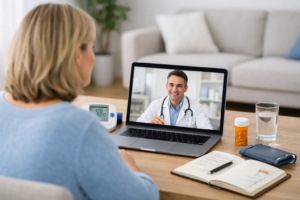
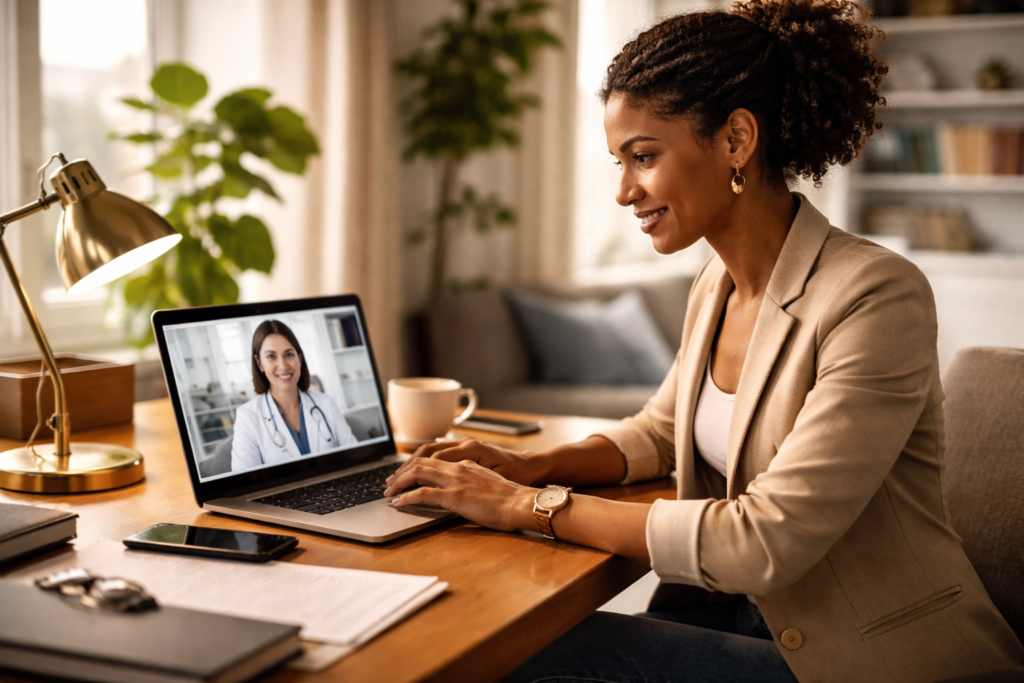
The possibility of making an appointment with a doctor online through the convenience of the home or even an office during a meeting in between untaps various points of friction.
There’s no commute.
No check-in desk.
No line of other patients waiting.
To individuals who work from home or travel much or those with hybrid working hours, that flexibility will ensure healthcare becomes more convenient to maintain.
Great For Minor but Disruptive Conditions
Enaged professionals do not always require complex clinical analyses. Most of the time, they have to confront something they are not used to and that is simple:
- Cold and flu symptoms
- Sinus pressure
- Allergies
- Mild infections
- Medication refills
Such cases directly belong to virtual healthcare of common diseases, where a distant consultation is usually enough.
A telehealth doctor for mild symptoms can offer guidance in a short period of time without the need for a fully in-person visit because symptoms are manageable and can be described clearly.
Reduced Time Off Work
The traditional appointments usually imply making a time off request, a meeting rearrangement or a workload compression.
Disruption is minimized through telemedicine.
A meeting that may require a few hours face-to-face may be finished within less than half an hour online. That efficiency enables the professionals to continue the working process and at the same time to respond responsibly to the health.
It is not necessarily that the key difference is the access to medical services but the continuity of workflow.
Quickened Prescription Processing.
Another area that saves a considerable amount of time through telemedicine is prescription renewals.
Millions of practitioners consult an online doctor to request prescription refill, especially the long-term drugs. They do not even need to make a visit to a clinic, making a quick consultation and ordering the prescriptions delivered to their pharmacy.
In the case of repeat medication, this system eliminates unneeded procedures without jeopardizing the quality of medical control.
Assistive to Uninsured or Between Plan.
The transition of careers may even involve a period of lapse in insurance.
An uninsured online doctor visit can in such cases provide a predictable out-of-pocket pricing. This can be financially less demanding as compared to emergency room visits or urgent care visits, which are usually more expensive in cases that are not emergencies.
Cost transparency is an added convenience to freelancers, consultants, and anybody in the business as an entrepreneur.
What Telemedicine Really Cannot Replace.
It is worth making it clear that telemedicine cannot be used everywhere.
It is effective as telemedicine treatment when dealing with non emergency cases. The worst symptoms, those that have no apparent cause, or a need to take diagnostic tests are still in need of a personal approach.
Telemedicine is not a complete substitute of traditional healthcare but a tool that busy professionals need to consider as a strategic solution.
The Psychological Advantage: Reduced Avoidance.
Another minor benefit should be mentioned.
When care is more accessible, individuals will not withhold access to care.
Most of the professionals delay appointments simply because they are not feeling that bad, but it is the inconvenience that really deters them. Telemedicine reduces that obstacle. Handling small issues can ensure that they do not develop into bigger problems that will take a longer time to resolve and leave out of work.
There are occasions when time saving in the long run begins by not deferring minor issues.
A Practical Example
The current telemedicine systems are designed to be efficient and yet maintain the medical quality. As an example, such services as FastDocNow provide online consultation with common and non-emergency conditions, where a patient can communicate with an authorized clinician quickly and without frivolous delays in scheduling.
This model fits professional life well, as long as it is used properly.
Is Telemedicine the optimal option in all cases among professionals?
Not always.
In case a condition involves practical investigation, radiography, or immediate treatment, face-to-face care is necessary.
Telemedicine provides a means of resolving a problem without disrupting a whole work day with less serious health issues that are easy to manage.
It is not only convenient, but a proportional response. Minor problems do not involve huge time investment.
Final Thoughts
Time is mostly the scarce resource for busy professionals. Telemedicine does not kill traditional healthcare, but it provides an option that is more conveniently placed within the hectic schedule.
Telemedicine can also make professionals remain productive and take care of simple conditions without neglecting their health because they have access to faster quality healthcare, lower traveling and waiting time, and helping to reduce the effects on their work.
Being used strategically, it is not deciding between speed and safety, rather it is deciding efficiency where appropriate.