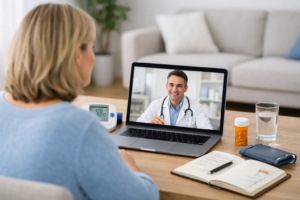

Telemedicine is not just about convenience anymore; it has grown into an integral part of the general healthcare system. In the United States, you will find a lot of people choosing a same day online doctor consultation USA instead of the regular in-person care that gets them wasting time in waiting rooms.
As telemedicine is growing, several misconceptions are also growing with it. You will find people saying things like “Online doctors are not real doctors.” Some people even believe that “you can’t get the right prescriptions through virtual care.” Another set of people are concerned about privacy issues. And some believe “telehealth is only useful for treating a minor cold.”
The purpose of this article is to separate reality from misconceptions and myth from fact.
If the option to talk to a doctor online without appointment or an online doctor visit for minor illness USA is appealing to you but you are holding back because you are not sure whether it’s a safe or legitimate medical care, this guide will give you the clarity you need to be decisive.
We’ll examine the most common misconceptions about telemedicine and explain what federal agencies, medical organizations, and clinical research actually say about it.
You will learn that telemedicine is not a medical shortcut but actually a standard medical care like the one you get in a hospital, and it is even more efficient and affordable, which is why millions of Americans are now choosing it.
Myth #1: Online Doctors Aren’t Real Doctors
One of the most common myths about telemedicine is that the doctors on the platforms are not “real doctors.” Some people hold the belief that these doctors are less qualified when compared to the ones in a physical hospital. Well, here is the fact below.
Fact: Telehealth Doctors Must Be Licensed and Regulated
In the United States, medical licensing is governed at the state level. Any physician who is providing virtual care must hold active licenses in the state where the patient is residing.
The general medical assumption is that when you receive virtual care, it is provided from your state and not from the state where the online doctor is located. That is why your online doctor must have a license to practice in your state, even if they are licensed in their own state.
Moreover, these doctors are also subject to the same professional standards, clinical guidelines, and malpractice laws as the doctors in physical hospitals.
When you talk to a licensed doctor online USA, you are not just speaking to some online fitness coach or blogger; you are actually speaking to a board-certified medical professional who has completed medical school, residency, and licensing exams.
Medical associations have clearly stated that the “standard of care” must remain consistent whether the care is delivered physically or delivered online. That means:
- Clinical documentation requirements apply.
- Diagnosis standards apply.
- Prescribing regulations apply.
- Ethical obligations apply.
Essentially, the only difference with telemedicine care is the medium through which it is provided, which is online. Telemedicine does not lower the bar in any way.
For example, if you have mild respiratory symptoms, you can use a virtual doctor for cold and flu USA to receive evaluation, treatment guidance, and, if appropriate, medication. The process is the same as the one physical doctors follow in a clinic; the only difference is the mode of communicating with your doctor, which can be through video or secure messaging.
The provider is real. The consultation is real. The medical accountability is real.
Myth #2: Telemedicine Is Only for Colds
Some people believe that telemedicine is only limited to minor colds. Well, here is the fact below.
Fact: Virtual Care Covers a Broad Range of Non-Emergency Conditions
According to public health authorities, telemedicine is appropriate for many non-emergency conditions. You will even find pages on the official U.S. Department of Health and Human Services (HHS) website dedicated to telehealthcare services.
It is very untrue to limit telemedicine to the healthcare service that only fixes colds. In reality, it covers non-emergency conditions like infections, chronic disease follow-ups, mental health support, dermatology concerns, and medication management.
Virtual care is an effective care option for:
- Cold & Flu
- Sinus Infection
- Urinary tract infections
- Pink Eye
- Acne
- Rashes & Itching
- Mild asthma symptoms
- Depression and General Anxiety
If you are experiencing sinus pressure, congestion, and facial discomfort, you can schedule a virtual doctor visit for sinus infection and receive the evaluation you need the same day. And if you are having urinary discomfort, you can also use telemedicine for uti treatment USA or even a virtual doctor visit for uti treatment to address your symptoms quickly.
These visits are known as telehealth services for common infections, and they are used by a lot of people in the country.
Telemedicine is also effective for ongoing management of chronic diseases like Hypertension and Asthma. You can get safe follow-up visits, medication adjustments, and lab review discussions through your telemedicine platform’s virtual medium.
You can also get the care you need for a dermatology case through virtual platforms. In an online doctor visit for skin rash, you can upload images through a secure portal and your provider will review them and also recommend the best treatment plan.
So, the assumption that telehealth is limited to colds is a myth and not even remotely close to the truth. Telemedicine addresses a wide category of mild to moderate conditions that do not require physical procedures or an emergency intervention.
Myth #3: Telemedicine Isn’t Safe or Private
Another misconception that often flies around about telemedicine is that one’s health information isn’t safe. Some people hold the belief that health data on the platform is susceptible to compromise. For that, here is the fact below.
Fact: Telemedicine Platforms Must Comply with Federal Privacy Laws
In the United States, HIPAA (Health Insurance Portability and Accountability Act) governs healthcare privacy. This body defines the rules and guidelines every telehealth provider must follow to keep their patients’ data safe.
Some of these guidelines include the non-negotiable use of secure systems that protect patient data, controlled access, and encryption (where it is necessary). You can learn more about the guidelines in our article: Is Online Healthcare Safe? Privacy and Security Explained
Confidentiality standards do not diminish because the care is given online. In fact, many reputable telehealth platforms design their systems to be safe, like the ones used by financial institutions.
It doesn’t matter if it is just a telehealth doctor for mild symptoms visit or other deeper consultations; your medical records, diagnoses, and communications are protected in the same way as in-person consultations.
In fact, people who need sensitive care, like an STI (Sexually Transmitted Infection) treatment or mental health support, sometimes prefer telemedicine. The reason is the increased privacy and total avoidance of potential stigmas.
Reputable telehealth platforms usually implement the following security protocols:
- Encrypted video sessions
- Secure patient portals
- Identity verification
- Controlled electronic prescription systems
When you use a reputable platform, a quick online doctor consultation USA will not be conducted on an open video platform.
For many adults who live in small communities, where almost everyone knows each other, virtual consultations can provide more privacy.
Myth #4: You Can’t Get Prescriptions Online
Another common misconception about telemedicine is the belief that online doctors can’t give legitimate prescriptions. For that, the fact is below.
Fact: Prescriptions Are Allowed When Clinically Appropriate
Federal and state laws regulate prescription authority. Any licensed physician, whether online or on-site, can prescribe many medications for you after a proper evaluation.
If you go to see a doctor online for prescription refill, they will first of all review your medical history, then confirm the stability of your condition, and finally determine whether a refill is safe for you or not.
This is usually common for:
- Blood pressure medications
- Birth Control
- Asthma inhalers
- Smoking Cessation therapies
- Depression treatment follow-ups
People usually use an online doctor for prescription refill USA for ongoing management when they don’t have new symptoms.
However, there are limits. Some controlled substances require stricter evaluation because of the governmental laws guiding them. Telemedicine providers usually follow federal prescribing rules carefully, just like any other doctor on-site would.
Myth #5: Telemedicine Is Expensive
Some people go with the assumption that virtual care is more expensive than physical care because of the convenience it brings. Well, for that again, the fact is below.
Fact: Virtual Care Is Often More Affordable
Research organizations that track healthcare spending have shown several times that telemedicine can reduce total healthcare costs.
It stands to reason because there is no facility overhead and consultations are conducted virtually.
An affordable telemedicine visit USA is often priced transparently. And if you are not insured, options like online urgent care without insurance, virtual urgent care without insurance, or online doctor visit without insurance USA can help you get the care you need.
Moreover, if all you are treating is a minor condition and are trying to save costs at the same time, a cheap online doctor consultation USA might be a good option for you; it costs less than a visit to the ER.
You should also know that cost savings is not limited to consultation fees. You also save:
- Transportation costs
- Time off work
- Childcare expenses
That’s why many adults opt for an online doctor visit without long wait instead of the traditional option that may be accompanied by delays.
Common Practical Applications of Telemedicine
A lot of people are adopting telemedicine because of how it addresses many everyday needs. Below is a list of some common applications.
Infections and Minor Illnesses
Conditions like Cold & Flu, Sinus Infection, Upper Respiratory Infection, Strep Throat, and UTI can be treated through virtual care. A virtual doctor visit for sinus infection or telemedicine for uti treatment USA helps you get the care you need without unnecessary delays.
Skin Conditions
If you have acne, minor rashes, and allergic reactions, your online doctor can address your issues through image review. What you will need to get started is an online doctor visit for skin rash.
Chronic Condition Monitoring
If you have Hypertension or are using GLP-1 medications, you can schedule your follow-ups through a telemedicine platform for quick diagnosis.
Work and School Documentation
If you need official notes for your work or school purposes, you can opt for a telehealth appointment same day USA to get an evaluation and then the documentation you need.
Busy Professionals
If you are a busy person who can’t afford to stay away from business for too long, virtual healthcare services for busy professionals is the option you need if your case is not a medical emergency.
When Telemedicine Is NOT Appropriate
Telemedicine is designed for non-emergency care. You should never consider it if you have any of the following:
- Chest pain
- Stroke symptoms
- Severe breathing difficulty
- Major trauma
- Uncontrolled bleeding
In such cases, you must immediately contact the emergency services in your state.
Virtual platforms are not designed for life-threatening conditions that require physical interventions. You should only think of it when your condition is stable and is not an emergency.
Why More Americans Are Choosing Virtual Care
Telemedicine actually surged during the time of COVID-19, when everyone was expected to stay at home to limit the spread of the virus. However, it has remained popular because of how convenient it is and how easy it is for people to access it.
Many people now go for:
- Fast online doctor visit USA
- Fast online doctor consultation America
- Online doctor visit from home USA
When you ask people why they choose it, these are their reasons:
- No waiting room exposure
- Flexible scheduling
- Reduced delays
Conclusion and Your Next Steps
It is true that telemedicine offers convenience and several other benefits, but it is not a replacement for physical hospitals and their emergency services. Certain health conditions may necessitate your immediate admission to an emergency room. Cases like that are beyond telemedicine’s specialization.
We have mentioned it severally in this article that you should only consider telemedicine if your condition is stable.
Another thing you should not forget is that getting cared for online does not mean standard medical procedures are not followed. Also, telemedicine is very much regulated, just as traditional healthcare is.
All the myths we covered in this article come from people who lack familiarity and information about how the service works. Telemedicine is designed to give people more access to healthcare, not to jeopardize their health.
If you have mild symptoms or need a refill or guidance, you can schedule a same day online doctor consultation USA.
You can also talk to a doctor online without appointment; rest assured, your care is coming from a licensed doctor.
If you have a sinus infection, UTI, rash, prescription renewal, or other nonemergency condition, telemedicine provides a very convenient way for you to get the solutions you need without leaving your room.